


Social commerce across the Balkans is accelerating as a structural shift in consumer behavior, not a peripheral trend. Serbia’s eCommerce market is projected to hit $1.65 billion by 2027 with 14%+ annual growth. Bulgaria’s B2C commerce has grown from €0.9 billion to €2.34 billion in five years, yet only half the population shops online. Facebook, Instagram, and TikTok are functioning as full purchase journey environments – not just referral sources. For brands willing to localize payment methods, adapt to mobile-first behavior, and navigate a split EU/non-EU regulatory landscape, the Balkans represent a high-growth, under-saturated social commerce opportunity.
Most Western eCommerce brands are still mapping Southeast Europe with outdated assumptions. While you’re debating whether the Balkans are “ready” for social commerce, local consumers are already buying fashion through Instagram, comparing electronics on Facebook Marketplace, and discovering trending products on TikTok. The infrastructure is live, the behavior has shifted, and the growth trajectory is measurable. Serbia’s eCommerce market is projected to hit $1.65 billion by 2027 with sustained 14%+ annual growth. Bulgaria’s B2C commerce has grown from €0.9 billion to €2.34 billion in five years, yet only half the population shops online – that participation gap is your opportunity. This isn’t emerging market speculation; it’s a field-tested playbook for capturing share in high-growth channels before competitive saturation sets in.
Table of Contents
- Understanding Balkan Social Commerce Growth and Market Dynamics
- Country-Specific Social Commerce Adoption Across the Balkans
- Consumer Behavior Driving Balkan Social Commerce Growth
- Leading Social Platforms and Payment Methods Shaping the Market
- Cross-Border Opportunities and Localization Strategies
- Challenges and Considerations for Market Entry
- Future Outlook for Balkan Social Commerce Growth
- Frequently Asked Questions
Understanding Balkan Social Commerce Growth and Market Dynamics
What is social commerce in the Balkan region?
Social commerce in the Balkans refers to the integration of the full purchase journey – discovery, evaluation, and transaction – within social platforms such as Facebook, Instagram, and TikTok. Unlike traditional eCommerce, which drives traffic to standalone websites, social commerce meets consumers within environments where they already spend time. In the Balkans, this distinction is especially significant because social platform penetration frequently exceeds eCommerce participation rates, creating a structural opportunity for brands that operate natively within these channels.
If you’re looking for a high-growth channel that most Western brands haven’t fully mapped yet, Southeast Europe deserves serious attention. Social commerce across the Balkans is evolving rapidly – not as a peripheral trend, but as a structural shift in how consumers discover, evaluate, and buy products. Rising smartphone penetration, expanding social media reach, and post-pandemic behavioral change have created a market dynamic that rewards early movers, highlighting where the eCommerce opportunities are in 2026.
The numbers tell a compelling story. In Serbia, approximately 70% of the population purchased at least one product online in 2021, accelerated by pandemic-driven behavioral shifts. By January 2023, social media users in Serbia reached 5.01 million – roughly 69.8% of the total population – with 390,000 new users added between 2021 and 2022 alone. Bulgaria shows a different but equally interesting profile: 85% of the population uses the internet, yet only 50% currently shop online. That gap between digital access and eCommerce participation is precisely where social commerce opportunity lives, offering a unique perspective on the complete 12-country CEE eCommerce landscape.
- Serbia social media reach: 5.01 million users as of January 2023, representing 69.8% of the total population, with 390,000 new users added between 2021 and 2022.
- Bulgaria participation gap: 85% internet penetration but only 50% of the population shopping online – the gap between digital access and eCommerce activity is the core opportunity.
- Platform role: Facebook, Instagram, and YouTube function as both discovery environments and transaction channels, not merely referral sources.
- Behavioral driver: Rising smartphone penetration, expanding social media reach, and post-pandemic behavioral change are the structural forces accelerating adoption.
What distinguishes social commerce from traditional eCommerce in this region is the role platforms play as both discovery environments and transaction channels. Facebook, Instagram, and YouTube aren’t just referral sources – they’re increasingly where the entire purchase journey happens. Understanding this distinction is the foundation for any effective market entry strategy in the Balkans, and it directly informs how you allocate budget across platforms and optimize for conversion within each environment.
Country-Specific Social Commerce Adoption Across the Balkans
The Balkans aren’t a monolithic market, and treating them as one is a strategic mistake. Each country sits at a different point on the digital commerce maturity curve, which means your entry sequencing and channel mix should vary accordingly.
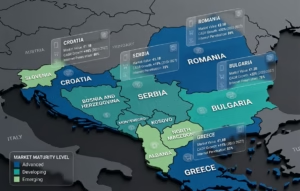
| Country | Key Market Metric | Online Shopper Penetration | Notable Growth Signal |
|---|---|---|---|
| Serbia | Projected $1.65B by 2027 | ~70% purchased online (2021) | 14.65%+ annual growth; clothing & electronics lead |
| Bulgaria | €2.34B B2C turnover | 50% (vs. 85% internet penetration) | Wide participation gap; eurozone entry Jan 2026 |
| Greece | €18.2B market value | 58% (up from 39% in 2019) | +19 percentage points in five years |
| Romania | Strong B2C growth | ~60% of internet users (Eurostat 2024; up from ~23% in 2019) | +32 percentage points in five years |
Serbia’s eCommerce sector is projected to grow 34.5% to reach $955.7 million in 2023, with annual growth expected to hold at least 14.65% through the following years – positioning the market to hit $1.65 billion in turnover by 2027. Clothing and sporting goods lead Serbian online purchases at 28.5%, followed by electronic equipment at 25.3%. This diverges sharply from global patterns where books and media typically dominate, signaling clear category-specific opportunities for fashion and electronics brands entering the market.
Bulgaria’s trajectory is equally instructive. B2C eCommerce turnover has grown from €0.9 billion to €2.34 billion over the past five years, yet the participation gap remains wide. With 85% internet penetration but only 50% of the population shopping online, Bulgaria represents one of the region’s most actionable conversion opportunities as consumer trust and payment infrastructure continue to mature.
Greece and Romania demonstrate what’s possible when digital infrastructure and consumer confidence align. Greece saw the share of its population shopping online jump from 39% to 58% between 2019 and 2024, with market value expanding to €18.2 billion. Romania’s growth was even more dramatic – the share of internet users shopping online surged from around 23% in 2019 to approximately 60% by 2024 (Eurostat), reflecting one of the fastest adoption trajectories in the EU. These trajectories aren’t outliers; they’re previews of what’s coming across the broader region, and they validate the investment case for brands willing to build localized social commerce operations now rather than waiting for market saturation.
Consumer Behavior Driving Balkan Social Commerce Growth
Balkan consumers are pragmatic, value-conscious, and increasingly mobile-first. Understanding how they actually behave on social platforms – rather than assuming they mirror Western European patterns – is what separates effective campaigns from wasted spend.

- Category preferences: Clothing and sporting goods lead Serbian online purchases at 28.5%, with electronics at 25.3% – diverging sharply from international markets where books and media dominate at roughly 60%.
- Platform behavior by age: Younger users engage with Facebook primarily as a discovery source; older demographics use it for personal communication – both creating distinct commerce touchpoints.
- Instagram’s role: Visual format drives purchase intent in fashion and lifestyle categories, shortening the evaluation cycle and generating direct purchase intent.
- YouTube’s role: Functions as a product education and comparison channel, particularly for higher-consideration purchases requiring demonstration content.
- Mobile-first reality: Smartphone penetration is driving fundamental shifts in how consumers move through the purchase funnel – from visual discovery through peer recommendations and influencer content, to checkout.
Product preferences in Serbia illustrate this clearly. Clothing and sporting goods lead online purchases at 28.5%, with electronics close behind at 25.3%. Compare that to international markets where books and media dominate at roughly 60%, and you see why category assumptions imported from other markets consistently underperform. Fashion and electronics brands that localize their social content for Balkan audiences are working with the current, not against it.
Social platforms function as dual-purpose environments across the region. Younger users engage with Facebook primarily as a discovery source, while older demographics use it for personal communication – both behaviors creating distinct touchpoints for commerce. Instagram’s visual format drives purchase intent in fashion and lifestyle categories, while YouTube serves as a product education and comparison channel. Serbia’s 5.01 million social media users, representing 69.8% of the population, form a base that continues to deepen its engagement with platform-native shopping features.
Mobile commerce is the dominant technical reality. Smartphone penetration is driving fundamental shifts in how consumers move through the purchase funnel – from visual discovery through peer recommendations and influencer content, to checkout. Brands that optimize for mobile-first experiences and integrate with social discovery mechanisms already embedded in daily routines will consistently outperform those that treat mobile as secondary. This behavioral foundation directly shapes which platforms you prioritize and how you structure your payment and checkout flows.
Leading Social Platforms and Payment Methods Shaping the Market
| Platform | Reach / Scale | Primary Commerce Role | Best-Fit Categories |
|---|---|---|---|
| 53.7% of Serbia’s population (ad reach, late 2025) | Discovery, marketplace, communication | Broad – highest-priority platform for most strategies | |
| Strong in fashion, beauty, lifestyle | Visual discovery, direct purchase intent | Fashion, beauty, lifestyle | |
| TikTok | 2.63M users aged 18+ in Bulgaria (late 2025); ~45% of internet users | Impulse discovery, trending products | Impulse categories, trend-driven products |
| YouTube | 4.50M users in Bulgaria | Product education, search, comparison | Higher-consideration purchases |
Facebook maintains the strongest commercial reach across the region, with advertising access equivalent to 53.7% of Serbia’s total population by late 2025. It functions simultaneously as a discovery channel, a marketplace, and a communication tool – making it the highest-priority platform for most Balkan social commerce strategies. Instagram has gained particular traction in fashion, beauty, and lifestyle categories, where visual content shortens the evaluation cycle and drives direct purchase intent.
TikTok is the breakout story worth tracking closely. The platform reached 2.63 million users aged 18+ in Bulgaria by late 2025, representing approximately 45% of internet users in that market. Its short-form video format is especially effective for impulse categories and trending products. YouTube’s reach of 4.50 million users in Bulgaria positions it as both a search tool and a product education channel – particularly valuable for higher-consideration purchases where consumers want demonstration content before committing.

- Debit cards: Accepted by approximately 74% of Bulgarian online shoppers as of 2026 – the baseline expectation for any Balkan checkout.
- Credit cards: Accepted by 38% of Bulgarian online shoppers and growing.
- Digital wallets: Adopted by 27% of Bulgarian online shoppers and gaining ground.
- Cash-on-delivery: Remains significant throughout the region, especially for first-time buyers and higher-value items.
- Trust signals: Over half of Bulgarian consumers prefer sellers that display SSL badges, strong payment protections, and trusted third-party processor credentials at checkout.
On the payments side, debit cards are accepted by approximately 74% of Bulgarian online shoppers as of 2026, making them the baseline expectation. Credit cards and digital wallets are gaining ground at 38% and 27% respectively, while cash-on-delivery remains significant throughout the region – especially for first-time buyers or higher-value items. Over half of Bulgarian consumers prefer sellers that display strong payment protections, SSL badges, and trusted third-party processor credentials at checkout. Missing dominant local payment methods is a direct conversion killer, and payment localization should be treated as a high-ROI infrastructure investment, not an afterthought. Getting this right creates a seamless bridge between platform discovery and completed transactions, which is where your cross-border expansion strategy either gains traction or stalls out.
Cross-Border Opportunities and Localization Strategies
The cross-border opportunity in the Balkans is real and measurable. The CEE region’s cross-border commerce is growing at 15% annually, with a projected market value of €124 billion. A 2024 CEE survey found that 57% of consumers in Eastern Europe already purchase from cross-border stores – meaning the consumer behavior is established, and the question is whether your brand is positioned to capture it. This highlights the importance of scaling eCommerce across the Balkans & CEE with effective cross-border growth and localization strategies.
What localization requires beyond translation
- Payment method alignment: Match local payment expectations – debit cards (74%), digital wallets (27%), and cash-on-delivery – to directly reduce checkout abandonment.
- Local currency pricing: Use local currency or eurozone pricing for EU members to eliminate conversion friction at checkout.
- Consumer protection compliance: Adhere to country-specific consumer protection rules, which vary significantly between EU and non-EU Balkan markets.
- Logistics partnerships: Establish carrier relationships that meet 4-to-5-day delivery expectations for cross-border shipments from Western Europe.
- Social content adaptation: Adapt content to local product preferences and platform behaviors rather than repurposing Western European creative.
- Market prioritization sequencing: Drive entry decisions using demand signals, competitive intensity, logistics complexity, and compliance requirements specific to each country.
Effective localization goes well beyond translation. Payment localization is your highest-leverage starting point: with debit cards accepted by 74% of Bulgarian shoppers and digital wallets at 27%, matching local payment expectations directly impacts checkout completion. The global average cart abandonment rate sits at 70.19%, and payment method availability is a primary driver of that friction. These considerations are crucial for developing global eCommerce strategies, cross-border solutions, and international expansion trends for modern retailers.
Market prioritization should be driven by demand signals, competitive intensity, logistics complexity, and compliance requirements. Bulgaria’s entry into the eurozone on January 1, 2026 is a meaningful structural change – currency barriers have been eliminated for EU-based sellers, simplifying pricing and reducing checkout friction previously caused by currency conversion. For brands sequencing their Balkan expansion, this makes Bulgaria an increasingly straightforward entry point alongside its existing EU regulatory alignment. Once you’ve validated product-market fit and operational workflows in one market, you can systematically expand to adjacent countries while adapting for local regulatory and consumer preference variations.
Challenges and Considerations for Market Entry
The Balkans present a split regulatory environment that requires deliberate planning. EU member states – Bulgaria, Romania, Greece, Croatia, and Hungary – operate under harmonized frameworks including GDPR, OSS/IOSS VAT schemes, consumer withdrawal rules, and product labeling requirements. Non-EU neighbors like Serbia, North Macedonia, Albania, Bosnia and Herzegovina, and Montenegro add customs workflows, duties, and distinct consumer protection regimes that directly affect your margin structure and delivery promises.
- EU member regulatory framework: Bulgaria, Romania, Greece, Croatia, and Hungary operate under GDPR, OSS/IOSS VAT, harmonized consumer protection rules, and product labeling requirements.
- Non-EU market complexity: Serbia, North Macedonia, Albania, Bosnia and Herzegovina, and Montenegro require customs workflows, duties management, and compliance with separate consumer protection regimes affecting margin and delivery timelines.
- Cash-on-delivery economics: COD expectations require tax workflows and delivery economics designed to accommodate this preference without destroying unit economics.
- Delivery time expectations: Many consumers expect cross-border shipments from Western Europe within 4 to 5 days; customs processing and last-mile fragmentation can introduce variability that damages conversion and repeat purchase.
- Consumer trust requirements: Transparent tracking, clear delivery windows, and upfront cost communication are essential operational requirements, not optional enhancements.
Beyond compliance, consumer trust dynamics create operational requirements that aren’t always obvious from the outside. Cash-on-delivery expectations mean you need to design tax workflows and delivery economics that accommodate this preference without destroying unit economics. Delivery time expectations are a real constraint – many consumers expect cross-border shipments from Western Europe within 4 to 5 days, yet customs processing and last-mile fragmentation can introduce variability. Poor delivery performance is one of the primary reasons shoppers abandon carts or switch to alternative sellers, making transparent tracking, clear delivery windows, and upfront cost communication essential for both conversion and repeat purchase. Addressing these operational realities upfront positions you to scale profitably rather than burning budget on acquisition while losing customers to fulfillment friction.
Future Outlook for Balkan Social Commerce Growth
The structural drivers of Balkan social commerce growth – deepening smartphone penetration, maturing payment ecosystems, and expanding social platform reach – aren’t slowing down. Serbia’s eCommerce sector is projected to maintain at least 14.65% annual growth through 2027, reaching $1.65 billion in turnover. Bulgaria’s B2C market has already grown from €0.9 billion to €2.34 billion over five years, and the participation gap between internet users and active online shoppers represents a substantial conversion runway still ahead. These trends are consistent with broader CEE eCommerce market insights, European eCommerce revenue, industry growth & forecast analysis.
- Serbia growth rate: Projected 14.65%+ annual eCommerce growth through 2027, reaching $1.65 billion in turnover.
- Bulgaria market expansion: B2C market grown from €0.9 billion to €2.34 billion over five years, with a substantial participation gap still to close.
- Platform-native commerce shift: Social commerce is moving from “click out to site” journeys toward platform-native storefronts, creator-tagged products, and in-app checkout experiences.
- Greece as a velocity benchmark: Online shopping penetration accelerated from 39% to 58% between 2019 and 2024 – demonstrating the speed possible when infrastructure, confidence, and merchant capability align.
- Category leadership window: Brands that establish localized operations, payment integrations, and platform-native commerce experiences now will own category leadership as these markets mature over the next three to five years.
The directional shift in platform behavior is equally significant. Social commerce is moving from “click out to site” journeys toward platform-native storefronts, creator-tagged products, and in-app checkout experiences that more closely resemble marketplace behavior. TikTok’s 2.63 million users aged 18+ in Bulgaria and Facebook’s advertising reach covering 53.7% of Serbia’s population are infrastructure assets for brands willing to build commerce workflows directly within these environments. Greece’s acceleration from 39% to 58% online shopping penetration between 2019 and 2024 demonstrates the velocity possible when infrastructure, confidence, and merchant capability align – and that alignment is actively developing across the broader Balkan region right now. The brands that establish localized operations, payment integrations, and platform-native commerce experiences today will own category leadership as these markets mature over the next three to five years.
Frequently Asked Questions
- What is social commerce, and how does it differ from traditional eCommerce in the Balkans? Social commerce integrates the entire purchase journey – discovery, evaluation, and transaction – within social platforms like Facebook, Instagram, and TikTok. Unlike traditional eCommerce, which relies on driving traffic to a standalone website, social commerce meets consumers where they already spend time, reducing friction and shortening the path to purchase. In the Balkans, this distinction matters because social platform penetration often exceeds eCommerce participation rates.
- Which Balkan country should I prioritize for market entry? Bulgaria and Serbia are strong starting points. Bulgaria offers EU regulatory alignment, growing B2C eCommerce (€2.34 billion), eurozone membership as of January 1, 2026, and a clear participation gap between internet users and active shoppers. Serbia offers a projected market of $1.65 billion by 2027 with strong social media penetration at 69.8% of the population.
- What social platforms drive the most commerce activity in the Balkans? Facebook leads in reach and transaction volume, with advertising access equivalent to 53.7% of Serbia’s population. Instagram drives purchase intent in fashion and lifestyle. TikTok is the fastest-growing platform for impulse commerce, reaching 45% of Bulgarian internet users aged 18+. YouTube functions as a product education and comparison channel with 4.50 million users in Bulgaria.
- What payment methods do I need to support for Balkan markets? Debit cards are accepted by approximately 74% of Bulgarian online shoppers as of 2026 and should be your baseline. Credit cards (38%) and digital wallets (27%) are growing. Cash-on-delivery remains significant, particularly for first-time buyers and higher-value purchases. Missing dominant local payment options directly increases cart abandonment.
- How significant is cross-border eCommerce in the region? Very significant. The CEE region’s cross-border commerce is growing at 15% annually toward a projected €124 billion market value. A 2024 CEE survey found that 57% of Eastern European consumers already purchase from cross-border stores, indicating established consumer readiness for international brands.
- What does localization actually require beyond translation? Effective localization requires payment method alignment, local currency pricing (or eurozone pricing for EU members), compliance with country-specific consumer protection rules, logistics partnerships that meet 4-to-5-day delivery expectations, and social content adapted to local product preferences and platform behaviors.
- What are the biggest regulatory differences between EU and non-EU Balkan markets? EU members (Bulgaria, Romania, Greece, Croatia, Hungary) operate under GDPR, OSS/IOSS VAT, and harmonized consumer protection rules. Non-EU markets (Serbia, North Macedonia, Albania, Bosnia and Herzegovina, Montenegro) require customs workflows, duties management, and compliance with separate consumer protection regimes that affect both margin and delivery timelines.
- What KPIs should I track for Balkan social commerce performance? Track platform-specific conversion rates by country, cart abandonment rates (benchmark: 70.19% global average), payment method adoption at checkout, delivery performance against stated windows, repeat purchase rate by market, and cost-per-acquisition by platform and country. These metrics will surface localization gaps faster than any other signal.
- How does TikTok fit into a Balkan social commerce strategy? TikTok is best deployed for impulse categories and trend-driven products. With 2.63 million users aged 18+ in Bulgaria alone by late 2025, the platform’s short-form video format drives discovery and purchase intent efficiently. Prioritize creator partnerships and product-tagged content to leverage its native commerce features.
- What growth rates can I realistically expect in Balkan social commerce markets? Serbia’s eCommerce sector is projected to grow at least 14.65% annually through 2027. Bulgaria’s B2C market has grown from €0.9 billion to €2.34 billion over five years. Greece accelerated online shopping penetration from 39% to 58% between 2019 and 2024. These are structural growth rates driven by infrastructure maturation, not short-term spikes – making the Balkans a durable long-term channel investment.
References
- Eurostat – eCommerce Statistics 2024. Romania: ~60% of internet users ordered online in 2024 (up from ~23% in 2019). Greece: 58% by 2024 (up from 39% in 2019).
- U.S. International Trade Administration – Serbia eCommerce Guide. Market projected to reach $1.65 billion by 2027, with ~14.65% annual growth.
- Baymard Institute – Cart Abandonment Rate Research. Global average cart abandonment: 70.19% (2024 aggregate across 44 studies).
- DataReportal – Digital 2024: Serbia. Social media users: 5.01 million (Jan 2023), 69.8% of population. Facebook advertising reach: 53.7% of population.
- DataReportal – Digital 2024: Bulgaria. TikTok: 2.63M users 18+ by late 2025 (~45% of internet users). YouTube: 4.50M users. Debit cards: 74% of online shoppers. Credit cards: 38%. Digital wallets: 27%.
- European Commission – Bulgaria Euro Adoption. Bulgaria joined the eurozone on 1 January 2026. Conversion rate: 1.95583 BGN/EUR.