


Scaling an eCommerce business into Central and Eastern Europe (CEE) presents unique challenges and opportunities. Unlike the relatively uniform markets of Western Europe, CEE demands a nuanced understanding of diverse economies, consumer behaviors, and regulatory landscapes. To achieve sustainable profit margins, you need strategies tailored to each country’s specific dynamics. This guide provides field-tested insights into pricing, conversion optimization, revenue growth, and cost reduction, equipping you with the knowledge to navigate the complexities of the CEE eCommerce landscape and drive ROI.
Table of Contents
- Understanding eCommerce Profitability in the CEE Market
- eCommerce Pricing Strategies for CEE Markets
- eCommerce Conversion Optimization Techniques
- eCommerce Revenue Optimization Through Market Expansion
- Strategies to Reduce eCommerce Costs and Improve Profit Margins
- Proven Tactics to Increase eCommerce Profits in CEE
- Measuring and Optimizing eCommerce Profitability Performance
- FAQ
Understanding eCommerce Profitability in the CEE Market
If you’re scaling an eCommerce operation into Central and Eastern Europe, accept this upfront: the rules are different here. Profitability in CEE isn’t simply a function of volume and margin – it’s shaped by a patchwork of economies, consumer behaviors, regulatory environments, and infrastructure realities that vary dramatically from one country to the next. For a detailed understanding of navigating the complete 12-country CEE eCommerce market, it’s essential to consider these nuances.
Unlike Western European markets – where relatively uniform purchasing power and payment infrastructure allow for standardized strategies – CEE demands a more granular approach. Poland, Romania, the Czech Republic, Hungary, and Bulgaria each present distinct cost structures, competitive intensities, and consumer expectations. A margin that looks healthy in Warsaw may be unsustainable in Sofia once logistics costs and return rates are accounted for at the country level. For comprehensive CEE eCommerce market insights, including European eCommerce revenue and industry growth forecasts, further analysis is available.
What Defines eCommerce Profit Margins in CEE
- Market fragmentation: You can’t treat CEE as a single addressable market – each country requires its own operational and commercial logic.
- Localized payment preferences: While card adoption is growing, cash-on-delivery and local payment methods still drive significant transaction volume in several markets, directly affecting cash flow and fraud exposure.
- Variable logistics infrastructure: Last-mile delivery costs and reliability differ enough between urban and rural areas to materially impact unit economics.
Getting these dynamics right before you optimize anything else is the foundation of a profitable CEE strategy.
With a firm grasp of the CEE market’s unique dynamics, the next step is to implement effective pricing strategies that resonate with local consumers and drive sales.
eCommerce Pricing Strategies for CEE Markets
Pricing is where many eCommerce businesses make their first – and most costly – mistake in CEE. Applying a single price list across the region, or simply converting Western European prices at current exchange rates, almost always results in either leaving money on the table or pricing yourself out of markets where consumers are acutely value-conscious.
The most effective approach starts with localized pricing – calibrating price points to reflect the actual purchasing power and competitive benchmarks of each individual market. A product priced at €49 in Germany might need to sit at the equivalent of €32 in Romania to achieve comparable conversion rates, even after accounting for currency differences.This isn’t discounting; it’s market-appropriate positioning.

Core eCommerce Pricing Strategies for CEE
- Localized pricing: Calibrate price points to reflect the actual purchasing power and competitive benchmarks of each individual market rather than applying uniform Western European rates.
- Dynamic pricing: Adjust prices in response to real-time demand signals, competitor movements, and inventory levels using tools like Prisync, Omnia Retail, and Dealavo. Pair with clear communication and consistent value messaging to maintain consumer trust.
- Competitive analysis: Monitor not just direct competitors but local marketplaces like Allegro in Poland or eMAG in Romania to understand how similar products are positioned.
- Transparent pricing: Display prices in local currencies with all taxes and fees included upfront – in many CEE markets, this is the baseline expectation that separates trusted brands from those that feel foreign and opaque.
With pricing optimized for local markets, the next critical step is to enhance the user experience to maximize conversion rates.
eCommerce Conversion Optimization Techniques
Driving traffic to your CEE storefront is only half the equation. If your conversion rate underperforms, every zloty, leu, or forint spent on acquisition is working harder than it needs to. Conversion optimization in CEE follows a clear hierarchy of impact, and the highest-leverage improvements are often straightforward to implement.
How to Improve Conversion Rates in CEE eCommerce
- Optimize user experience fundamentals. Fast page load times, mobile-first design, and intuitive navigation are non-negotiable – CEE consumers increasingly shop on mobile, and a clunky checkout experience on a smartphone is a direct revenue leak. Google’s Core Web Vitals provide a useful benchmark: aim for a Largest Contentful Paint under 2.5 seconds and a Cumulative Layout Shift score below 0.1.
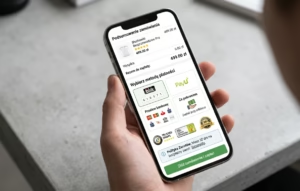
- Expand payment optionality. Offering only international card payments will cost you meaningful transaction volume in markets where BLIK (Poland), PayU, or local bank transfers dominate consumer preference. Map your payment stack to each market’s actual usage patterns, not just what’s easiest to integrate.
- Implement trust signals. Verified customer reviews, clear return policies in the local language, and visible security certifications all reduce purchase hesitation. A/B testing these elements systematically using tools like VWO or Google Optimize lets you quantify their impact rather than guess.
- Deploy personalization. Tailored product recommendations based on browsing history, localized promotional messaging, and dynamic content rounds out a conversion program that compounds over time as your data set grows.
Once you’ve optimized your conversion funnel, expanding into new markets can significantly boost your revenue. However, this requires a strategic approach to navigate the complexities of cross-border eCommerce.
eCommerce Revenue Optimization Through Market Expansion
Once you’ve established a profitable baseline in your primary CEE market, expansion is the most powerful revenue growth lever available. The region’s geographic density means a well-executed multi-market strategy can dramatically increase your addressable customer base without proportional overhead increases – but only with operational discipline. For comprehensive insights into scaling eCommerce across the Balkans & CEE, including cross-border growth and localization strategies, further resources are available.
Multi-Market Revenue Optimization Strategies
- Marketplace integration: Platforms like Allegro in Poland, eMAG in Romania, Mall Group across Czech Republic and Slovakia, and Emag.bg in Bulgaria give you immediate access to established consumer audiences without the cost of building brand awareness from scratch. Treat marketplace presence as a customer acquisition channel while building your direct-to-consumer capability in parallel.
- Localized marketing: Generic machine-translated campaigns rarely resonate – CEE consumers respond to messaging that reflects their cultural context, local references, and language nuances. Partnering with local influencers or regional content creators accelerates trust-building in ways that paid media alone cannot replicate. A complete guide to CEE eCommerce localization strategy can provide further details on adapting your approach for Eastern Europe markets.
- Multi-market operational infrastructure: Managing multi-market complexity requires systems that handle multiple currencies, tax regimes, and fulfillment networks simultaneously. Platforms like Shopify Markets, Salesforce Commerce Cloud, or purpose-built CEE solutions reduce the technical burden considerably.
- Country-level unit economics tracking: The KPI to watch as you expand is revenue per market relative to the incremental cost of serving that market – expansion only creates value when unit economics hold at the country level.
While expanding revenue is crucial, it’s equally important to manage costs effectively to maintain healthy profit margins. Let’s explore strategies to reduce eCommerce costs in the CEE region.
Strategies to Reduce eCommerce Costs and Improve Profit Margins
Revenue growth without cost discipline is a treadmill, not a business. In CEE, where margins are often thinner than in Western markets due to lower average order values and higher relative logistics costs, operational efficiency isn’t optional – it’s the difference between a sustainable operation and one that grows itself into a cash flow crisis.
Highest-Impact Cost Reduction Strategies for CEE eCommerce
- Supply chain optimization: Renegotiating supplier terms, consolidating purchase orders to hit volume thresholds, and reducing SKU complexity all lower your cost of goods. Demand forecasting tools like Inventory Planner or Brightpearl help you avoid the twin margin killers of stockouts and overstock.
- Automation: Order processing, customer service triage, returns management, and performance marketing reporting are all areas where automation tools – from Zapier workflows to dedicated eCommerce ERPs – reduce labor costs while improving consistency. The ROI on automation investments in CEE operations is typically fast, given the relatively high proportion of manual processes in earlier-stage operations.
- Returns reduction: Investing in detailed product descriptions, accurate sizing guides, high-resolution imagery, and video demonstrations reduces return likelihood at the source. In CEE markets, the cost of processing a return can easily consume 20–65% of the original order value (National Retail Federation, 2024).
- Logistics optimization: Negotiating carrier rates based on volume, using regional fulfillment hubs to reduce last-mile costs, and offering delivery options that match consumer preferences further improves per-order economics across CEE markets.

With a focus on cost reduction, it’s essential to implement proven tactics that boost profits by enhancing customer loyalty and increasing order values.
Proven Tactics to Increase eCommerce Profits in CEE
Acquiring a new customer in CEE costs real money. Retaining that customer and increasing their lifetime value is where the profit actually lives. The most consistently effective profit-boosting tactics in this region share a common thread: they deepen relationships with existing customers rather than chasing perpetual new acquisition.
- Loyalty programs adapted to local preferences: Programs offering tangible, near-term rewards – cashback, exclusive discounts, early access to sales – drive repeat purchase behavior more effectively than aspirational tier structures. Pair loyalty mechanics with personalized email and SMS marketing triggered by purchase behavior to create a retention engine that compounds over time.
- Upselling and cross-selling: Recommending a complementary product at checkout or offering a premium bundle at a modest price premium above the base product works across CEE consumer segments. The key is relevance – recommendations that feel random or purely commercial are ignored or create friction that costs you the sale entirely.
- Customer service quality: In markets where word-of-mouth and peer reviews carry significant weight, a single exceptional service interaction can generate repeat purchases and referrals that no paid campaign can replicate at the same cost. Investing in local-language support, fast response times, and empowered agents who resolve issues without escalation pays dividends in customer lifetime value that show up directly in your profitability metrics.
To ensure these tactics are effective, it’s crucial to measure performance and optimize your strategies based on data-driven insights.
Measuring and Optimizing eCommerce Profitability Performance
You can’t optimize what you don’t measure, and in a multi-market CEE operation, the measurement framework matters as much as the tactics. Businesses that consistently improve profitability track the right metrics at the right level of granularity – by market, by channel, and by customer segment.
Key KPIs for CEE eCommerce Profitability
| KPI | What It Measures | Target / Benchmark | Primary Lever |
|---|---|---|---|
| Gross Profit Margin (by country) | Revenue minus cost of goods at the market level | Track individually per market | Pricing, supply chain optimization |
| Net Profit Margin (by country) | Profitability after all operating costs per market | Track individually per market | Cost reduction, logistics optimization |
| CLTV:CAC Ratio | Customer lifetime value relative to acquisition cost | 3:1 or higher | Retention programs, acquisition efficiency |
| Average Order Value (AOV) | Mean revenue per completed transaction | Improve over time | Upselling, bundling tactics |
| Cart Abandonment Rate | Share of initiated checkouts not completed | Reduce over time | Checkout optimization, payment optionality |
| Return Rate | Share of orders returned by customers | Reduce over time | Product content quality, expectation-setting |

At the top of your KPI stack, track gross profit margin and net profit margin at the country level, not just in aggregate. Blended numbers hide the reality that one market may be subsidizing another. Below that, customer acquisition cost (CAC) and customer lifetime value (CLTV) tell you whether your growth is actually creating value. A healthy CLTV:CAC ratio – generally considered to be 3:1 or higher – indicates a sustainable acquisition model. If that ratio is compressing, you need to either reduce acquisition costs or accelerate retention.
Average order value (AOV), cart abandonment rate, and return rate round out the operational KPI set. Each connects directly to a lever you can pull: AOV responds to upselling and bundling tactics, abandonment rate responds to checkout optimization and payment optionality, and return rate responds to product content quality and expectation-setting.
For tooling, Google Analytics 4 combined with a BI layer like Looker Studio or Tableau gives you the visibility to analyze performance across markets and channels. More sophisticated operations use cohort analysis to understand how customer behavior evolves over time – a particularly valuable lens in CEE markets where consumer trust in eCommerce is still maturing and early cohorts often show improving retention as brand familiarity grows. Reviewing these metrics monthly, adjusting strategies based on what the data shows, and setting clear improvement targets by quarter is what separates eCommerce businesses that scale profitably from those that simply scale.
By implementing these strategies and continuously monitoring your performance, you can achieve sustainable eCommerce profitability in the CEE region. For further insights, explore the following frequently asked questions. Additionally, for a complete growth strategy with digital marketing and conversion optimization to grow your eCommerce business, refer to our comprehensive guide.
FAQ: eCommerce Profitability Optimization in CEE
- What makes CEE eCommerce markets different from Western European markets in terms of profitability? CEE markets typically feature lower average order values, higher price sensitivity, more fragmented payment preferences, and variable logistics infrastructure. These factors compress margins relative to Western Europe, requiring more granular cost management and localized strategies to achieve comparable profitability.
- Which pricing strategy works best across multiple CEE countries simultaneously? Localized pricing – calibrated to each country’s purchasing power and competitive landscape – consistently outperforms uniform pricing. Combine it with dynamic pricing tools like Prisync or Omnia Retail to respond to real-time market conditions while maintaining transparency with consumers.
- What payment methods should I prioritize to maximize conversion rates in CEE? Prioritize market-specific methods: BLIK in Poland, PayU across multiple CEE markets, local bank transfers, and cash-on-delivery where it remains prevalent. Mapping your payment stack to actual consumer behavior in each market is one of the highest-ROI conversion improvements available.
- How do I manage the operational complexity of selling across multiple CEE markets? Invest in a commerce platform that natively supports multi-currency, multi-tax, and multi-fulfillment operations – Shopify Markets or Salesforce Commerce Cloud are strong options. Treat each market as a distinct P&L and track unit economics at the country level to identify where expansion is genuinely profitable.
- What’s the fastest way to enter a new CEE market and generate revenue? Marketplace integration – listing on Allegro, eMAG, or Mall Group – provides immediate access to established consumer audiences. Use marketplace presence to generate early revenue and gather market intelligence while building your direct-to-consumer channel in parallel.
- How can I reduce return rates in CEE without hurting conversion? Invest in detailed product content: accurate sizing guides, high-resolution images, and product videos. Clear expectation-setting before purchase reduces post-purchase disappointment, which is the primary driver of returns – improving both conversion and margin simultaneously.
- What KPIs should I track to monitor eCommerce profitability in CEE? Track gross and net profit margin by country, CLTV:CAC ratio (target 3:1 or higher), average order value, cart abandonment rate, and return rate. Review these monthly at the market level to identify where to focus optimization efforts.
- How effective are loyalty programs in CEE markets? Highly effective when designed around tangible, near-term rewards like cashback and exclusive discounts rather than aspirational tier structures. CEE consumers respond strongly to programs that deliver immediate, visible value given the region’s price sensitivity.
- What automation tools deliver the best ROI for CEE eCommerce operations? Order processing automation, customer service chatbots for first-line triage, and automated performance marketing reporting deliver fast ROI. Inventory planning tools like Inventory Planner or Brightpearl also pay back quickly by reducing overstock and stockout costs.
- How long does it typically take to see measurable profitability improvements after implementing these strategies? Pricing and conversion optimizations can show measurable impact within 30–60 days. Retention and lifetime value improvements typically take 3–6 months to appear in cohort data. Supply chain and logistics optimizations often deliver results within a quarter once new contracts or processes are in place.
References
- Shopify – eCommerce Returns: Average Return Rate and How to Reduce It (2025). Source for return processing cost = 20–65% of item value, citing NRF 2024 report.
- National Retail Federation – 2024 Consumer Returns in the Retail Industry. Primary data source for eCommerce return rates and processing costs.
- Shopify – How To Calculate Customer Lifetime Value (2025). Source for LTV:CAC benchmark of 3:1.
- Google web.dev – Largest Contentful Paint (LCP). Official Core Web Vitals threshold: LCP ≤ 2.5 seconds, CLS ≤ 0.1.
- eCommerce Europe – European eCommerce Report 2025. Context for CEE market dynamics and growth trajectory.