

If you’re expanding your eCommerce operations into Central and Eastern Europe, navigating the value-added tax (VAT) system is critical. VAT is a consumption tax applied at each stage of the supply chain, with the end consumer ultimately bearing the cost. As an eCommerce business, you act as a collection agent, charging VAT on sales, reclaiming it on eligible purchases, and remitting the net amount to the local tax authority. Successfully managing this process requires understanding the nuances of the EU VAT framework and the specific regulations of each CEE country.
The CEE region presents unique challenges and opportunities due to the autonomy each member state has over its VAT rates, exemptions, and administrative procedures. For example, Poland, Hungary, Romania, and the Czech Republic each have their own compliance calendars, registration thresholds, and reporting formats. Mastering these distinctions is not just about legal compliance; it’s a strategic advantage that can significantly impact your profitability and competitiveness. Let’s dive into the essentials of VAT compliance in the CEE region to ensure your business is set up for success.
Table of Contents
- Understanding VAT in the European Union and CEE Region
- VAT Rates and Country-Specific Requirements
- How VAT Works for Cross-Border Transactions
- VAT Compliance Essentials for CEE Businesses
- Registration, Reporting, and Documentation Requirements
- Common Challenges and Best Practices
- FAQ
Cross-border VAT compliance in the CEE requires businesses to register where triggered, charge destination-country rates on B2C sales above €10,000, apply the reverse charge mechanism for B2B transactions, and file accurate returns – monthly or quarterly – in each country where obligations exist. The EU’s One Stop Shop (OSS) scheme simplifies multi-market B2C reporting into a single quarterly return. Key CEE standard rates range from 21% (Romania) to 27% (Hungary), and countries like Poland impose additional invoice-level reporting requirements such as JPK_VAT. Proactive compliance mapping, local tax partnerships, and tax automation tools are the foundation of scalable CEE operations.
Understanding VAT in the European Union and CEE Region
What is VAT in the European Union?
Value-added tax (VAT) is a consumption tax applied at every stage of the supply chain – from raw materials to the final sale – with the end consumer bearing the full cost. Businesses act as collection agents, charging VAT on sales and reclaiming it on purchases, then remitting the net amount to their local tax authority. All EU member states operate under a shared VAT directive, but each country retains meaningful autonomy over its rates, exemptions, and administrative procedures.
If you’re scaling an eCommerce operation into Central and Eastern Europe, the first thing to internalize is how value-added tax functions within the EU’s economic framework. Value-added tax is a consumption tax applied at every stage of the supply chain – from raw materials to the final sale – with the end consumer bearing the full cost. Businesses act as collection agents, charging VAT on sales and reclaiming it on purchases, then remitting the net amount to their local tax authority.
What makes the CEE region both interesting and complex is that while all EU member states operate under a shared VAT directive, each country retains meaningful autonomy over its rates, exemptions, and administrative procedures. Poland, Hungary, Romania, and the Czech Republic each maintain their own compliance calendars, registration thresholds, and reporting formats. Understanding these distinctions isn’t just a legal obligation – it’s a competitive advantage for businesses that get it right from day one.
- Shared EU VAT Directive: All CEE member states operate under a common EU framework, ensuring baseline consistency in how VAT is structured across borders.
- Country-level autonomy: Each CEE country sets its own rates, exemptions, registration thresholds, and reporting formats independently.
- Business role as collection agent: Businesses charge VAT on sales, reclaim it on eligible purchases, and remit the net amount to the local tax authority.
- Compliance as competitive advantage: Mastering country-specific distinctions from day one protects profitability and reduces audit exposure.
Now that we’ve established the fundamental role of VAT within the EU and CEE, let’s examine the specific VAT rates and country-specific requirements that directly impact your pricing and profitability.
VAT Tax in Europe – Rates and Country-Specific Requirements
| Country | Standard VAT Rate | Reduced Rate Range |
|---|---|---|
| Hungary | 27% | 5% – 18% |
| Poland | 23% | 5% – 8% |
| Czech Republic | 21% | 12% |
| Slovakia | 20% | 10% |
| Bulgaria | 20% | 9% |
| Romania | 21% | 11% (main), 5% (exceptions) |
| Luxembourg | 17% | 3% – 14% |
VAT rates across the EU are far from uniform. Standard rates currently range from 17% (Luxembourg) to 27% (Hungary). Romania applies 21%, Poland charges 23%, the Czech Republic maintains 21%, Slovakia 20%, and Bulgaria 20%. These aren’t minor differences – they directly affect your pricing model and margin calculations in each market.
Beyond standard rates, most countries apply reduced rates – typically between 5% and 13% – to categories like food, pharmaceuticals, books, and cultural services. For eCommerce operators, your product catalog may attract different tax rates depending on both the destination country and product classification. Misclassifying a product and applying the wrong rate is one of the most common and costly compliance errors in cross-border EU trade. Build a rate matrix by country and product category into your pricing model before launch – it pays dividends immediately.
Understanding these rate variations is crucial, but equally important is knowing how VAT applies to cross-border transactions. Let’s explore the mechanics of VAT in intra-EU trade and how to navigate the complexities of B2B and B2C sales.
How VAT Works in Europe for Cross-Border Transactions
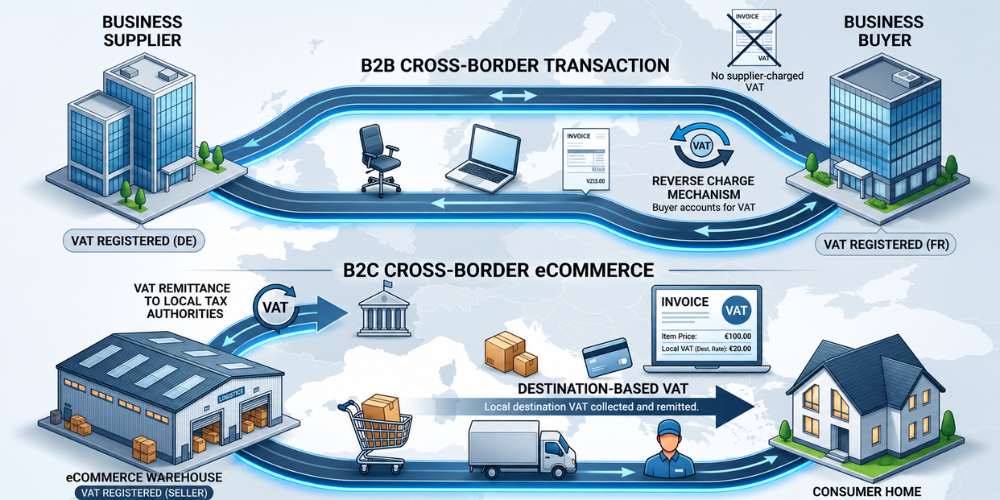
- B2B reverse charge mechanism: VAT liability shifts to the VAT-registered buyer, who self-accounts for the tax in their own country – simplifying the seller’s obligations provided documentation is correct.
- B2C destination-based VAT: Once cross-border B2C sales exceed €10,000 annually across all EU countries combined, VAT must be charged at the rate applicable in the customer’s country.
- One Stop Shop (OSS): An EU-wide scheme introduced in 2021 allowing businesses to file a single quarterly return covering all EU B2C cross-border sales, eliminating the need for separate registrations in every destination country.
Cross-border VAT mechanics within the EU are a crucial part of effective global eCommerce strategies, hinging on one critical distinction: whether you’re selling business-to-business (B2B) or business-to-consumer (B2C). For B2B transactions, the reverse charge mechanism typically applies – the VAT liability shifts to the buyer, who self-accounts for the tax in their own country. This simplifies the seller’s obligations considerably, provided both parties are VAT-registered and the transaction is properly documented.
For B2C transactions, the rules changed significantly with the EU’s 2021 VAT reform. Once your cross-border B2C sales exceed €10,000 annually across all EU countries combined, you’re required to charge VAT at the rate applicable in the customer’s country. The One Stop Shop (OSS) scheme was introduced to manage this complexity, allowing you to file a single quarterly return covering all EU B2C sales rather than registering separately in every destination country. If you’re not already using OSS, it should be your next compliance priority.
With a clear understanding of how VAT works for cross-border transactions, let’s outline the essential compliance steps your business must take to operate smoothly within the CEE region.
VAT Compliance Essentials for CEE Businesses
Operating across CEE borders means managing a patchwork of national implementations of the EU VAT Directive – not a single unified framework. The fundamental obligations are consistent: register where required, charge the correct rate, issue compliant invoices, file returns on time, and maintain adequate records. But the specifics vary enough that a one-size-fits-all approach will eventually create gaps.
Core VAT Compliance Obligations for CEE Operations
- Register where required: Determine registration obligations in each CEE country based on inventory location, sales thresholds, and transaction types.
- Charge the correct rate: Apply the accurate standard or reduced VAT rate for each product category in each destination country.
- Issue compliant invoices: Ensure all invoices meet the legal requirements of the relevant CEE jurisdiction, including mandatory fields and VAT number references.
- File returns on time: Adhere to each country’s reporting cadence – monthly or quarterly – and submit via the required format.
- Maintain adequate records: Archive invoice-level transactional data and supporting documentation for the minimum retention period required in each country.
Registration triggers deserve close attention. Storing inventory in a CEE country – through a fulfillment center or third-party logistics provider – typically creates a VAT registration obligation in that country regardless of sales volume. Exceeding the €10,000 B2C threshold without enrolling in OSS means local registrations in each destination market. Mapping your physical and digital footprint against each country’s registration rules early prevents the expensive retroactive registrations that catch many operators off guard. Businesses that establish this mapping exercise as a standard part of market entry planning consistently avoid the compliance gaps that create audit exposure later.
Now that we’ve covered the essentials, let’s delve into the specific registration, reporting, and documentation requirements that will keep your business compliant and audit-ready.
Registration, Reporting, and Documentation Requirements

- Reporting cadence: Most CEE countries require monthly or quarterly VAT returns; confirm the specific schedule for each country where you are registered.
- Poland’s JPK_VAT: Poland mandates detailed invoice-level transactional reporting via its Standard Audit File for Tax – summary-level bookkeeping does not satisfy Polish tax authorities.
- Intra-EU B2B documentation: Zero-rated supplies require a valid customer VAT number, proof of cross-border transport, and a correctly issued invoice citing the applicable legal basis.
- Document retention: Archive all supporting evidence – transport documents, CMR notes, carrier confirmations – for at least 10 years in most CEE jurisdictions.
- Automated document capture: Invest in document management workflows that capture and archive transaction evidence automatically at the point of transaction.
Once you’ve determined where registration is required, the operational focus shifts to reporting cadence and documentation standards. Most CEE countries require monthly or quarterly VAT returns. Poland goes further with its JPK_VAT (Standard Audit File for Tax), mandating detailed invoice-level transactional reporting rather than summary figures. Your accounting systems must capture invoice-level data in a structured format exportable on demand – summary-level bookkeeping simply won’t satisfy Polish tax authorities.
Documentation requirements for exempt or zero-rated transactions are stringent across the region. For intra-EU B2B supplies, you need valid VAT identification numbers for your customers, proof of transport across borders, and correctly issued invoices referencing the applicable legal basis for zero-rating. Missing or inconsistent documentation is the primary reason tax authorities disallow zero-rated treatment during audits – converting what should have been a tax-free transaction into a taxable one, with penalties and interest attached. Invest in document management workflows that capture and archive this evidence automatically at the point of transaction.
While mastering these requirements is essential, it’s equally important to be aware of the common challenges businesses face in cross-border VAT management. Let’s explore these pitfalls and the best practices to avoid them.
Common Challenges and Best Practices for Cross-Border VAT Management

The most persistent challenge in CEE VAT compliance isn’t understanding the rules – it’s keeping pace with how individual countries interpret and enforce them, often revealing the hidden barriers of selling beyond the EU. Regulatory guidance evolves, audit priorities shift, and accepted practice from two years ago may now trigger scrutiny. Static compliance setups without ongoing monitoring are where businesses get caught out.
- Regulatory drift: Country-level interpretations and enforcement priorities change frequently – static compliance setups without ongoing monitoring create gaps.
- Product misclassification: Applying the wrong VAT rate due to incorrect product classification is one of the most common and costly cross-border errors.
- Missed registration triggers: Storing inventory locally or exceeding the €10,000 B2C threshold without OSS enrollment creates retroactive registration obligations.
- Documentation gaps: Incomplete transport evidence or missing customer VAT numbers cause tax authorities to disallow zero-rated treatment during audits.
- Reactive compliance posture: Treating VAT as a periodic filing exercise rather than a continuous process leaves businesses exposed to penalties and interest.
Best Practices for Scalable CEE VAT Compliance
- Partner with local tax advisors in your key CEE markets to stay current with country-specific regulatory changes and enforcement trends.
- Implement ERP or tax automation platforms – such as Avalara, Vertex, or country-specific solutions – that apply real-time rate and rule updates across all markets.
- Conduct internal compliance reviews at least annually, and trigger ad hoc reviews when entering new markets, adding fulfillment locations, or launching new product categories.
- Establish clear KPIs around filing accuracy, on-time submission rates, and audit readiness to give your finance team measurable targets and surface problems before they become penalties.
- Build compliance infrastructure in parallel with commercial growth – not as an afterthought – to scale successfully across CEE markets.
The most effective operators treat VAT compliance as a continuous process rather than a periodic filing exercise. That means partnering with local tax advisors in your key CEE markets, implementing ERP or tax automation platforms – Avalara, Vertex, or country-specific solutions – that apply real-time rate and rule updates, and conducting internal compliance reviews at least annually. Establish clear KPIs around filing accuracy, on-time submission rates, and audit readiness to give your finance team measurable targets and surface problems before they become penalties. The businesses that scale successfully across CEE build compliance infrastructure in parallel with commercial growth – not as an afterthought.
To further clarify any remaining questions, let’s address some frequently asked questions about cross-border VAT compliance in the CEE region.
FAQ: Cross-Border VAT Compliance in the CEE
- Do I need to register for VAT in every CEE country where I sell?
Not necessarily. If your total EU cross-border B2C sales are below €10,000 per year, you can charge your home country’s VAT rate. Above that threshold, either register locally in each destination country or use the EU’s One Stop Shop (OSS) scheme to file a single consolidated return. - What is the OSS scheme and should I use it?
OSS is an EU-wide simplification measure that lets you report and pay VAT on all B2C cross-border sales through a single quarterly return filed in your home country. For most eCommerce businesses selling across multiple EU markets, it’s the most practical and cost-effective compliance route available. - What triggers a mandatory VAT registration in a CEE country?
Storing inventory locally – even through a third-party warehouse or fulfillment partner – almost always creates a registration obligation. Exceeding the unified €10,000 EU B2C threshold without using OSS and making taxable service supplies locally are other common triggers. - How do I handle VAT on B2B sales to CEE customers?
For B2B transactions where your customer is VAT-registered, the reverse charge mechanism typically applies. Issue a zero-rated invoice, your customer self-accounts for VAT in their country, and you report the transaction on your EC Sales List. Always verify your customer’s VAT number via the EU’s VIES system before applying this treatment. - What are the standard VAT rates in key CEE countries?
Poland: 23%, Hungary: 27%, Romania: 21%, Czech Republic: 21%, Slovakia: 20%, Bulgaria: 20%. Reduced rates apply to specific product categories in each country, so always verify the applicable rate for your specific product classification. - What is Poland’s JPK_VAT and does it affect my business?
JPK_VAT is Poland’s Standard Audit File for Tax, requiring businesses VAT-registered in Poland to submit detailed invoice-level transactional data electronically each month. If you’re VAT-registered in Poland, your accounting system must generate this structured file format. - What documentation do I need to zero-rate an intra-EU B2B sale?
You need a valid VAT registration number for your customer (verified via VIES), a correctly issued invoice citing the reverse charge basis, and evidence that goods physically crossed the border – transport documents, CMR notes, or carrier confirmations. Archive everything for at least 10 years in most CEE jurisdictions. - Can I reclaim VAT paid in a CEE country where I’m not registered?
Yes, through the EU VAT Refund Directive (Directive 2008/9/EC). EU-based businesses reclaim foreign VAT via their home country’s tax portal. Non-EU businesses use the 13th Directive process. Claims are subject to deadlines – typically September 30 of the year following the expense – so don’t let refund opportunities lapse. - What tax automation tools work well for CEE VAT compliance?
Avalara and Vertex are widely used for rate determination and return preparation across EU markets. For businesses with significant Polish operations, local solutions integrated with JPK_VAT requirements are worth evaluating. Confirm any tool you choose receives real-time regulatory updates for each CEE country in your footprint. - How often should I review my CEE VAT compliance setup?
Conduct a formal compliance review at minimum annually, aligned with your fiscal year-end. Trigger an ad hoc review whenever you enter a new CEE market, add a fulfillment location, launch a new product category, or when a country announces significant regulatory changes. Proactive reviews cost a fraction of what reactive remediation does.
References
- European Commission – VAT Rates Applied in EU Member States. Hungary: 27%; Poland: 23%; Czech Republic: 21%; Slovakia: 20%; Bulgaria: 20%; Romania: 21%; Luxembourg: 17% (verified standard rates 2025–2026).
- European Commission – One Stop Shop (OSS). Introduced July 2021; single quarterly return covering all EU B2C cross-border sales above €10,000 threshold.
- EUR-Lex – Council Directive 2008/9/EC (VAT Refund Directive). EU business refund claims; September 30 deadline for previous year expenses.
- European Commission – VAT Registration Requirements. Local VAT registration obligations; document retention: minimum 10 years in most CEE jurisdictions.