


Expanding across the Balkans means navigating two fundamentally different regulatory universes: EU member states (Croatia, Bulgaria, Romania, Greece, Slovenia) operating under harmonized GDPR, eCommerce Directive, and Digital Services Act frameworks, and non-EU Western Balkan markets (Serbia, North Macedonia, Albania, Bosnia & Herzegovina, Montenegro, Kosovo) with fragmented, evolving compliance environments. The compliance gap is real and operationally costly – but it is narrowing. Businesses that design for regulatory divergence from the start, build to EU baseline standards, and layer market-specific adaptations on top will avoid costly retrofits and gain first-mover advantage as harmonization accelerates through 2027.
Expanding your eCommerce operation across the Balkans means confronting a regulatory reality that most market entry guides gloss over: you’re not entering a unified market with predictable compliance requirements. Instead, you’re navigating a region where EU member states operate under harmonized digital commerce regulations while their Western Balkans neighbors maintain fragmented, evolving regulatory frameworks that create real operational friction. A mid-sized fashion retailer we worked with learned this the hard way – their GDPR-compliant checkout flow worked flawlessly in Croatia and Bulgaria, but triggered compliance gaps in Serbia and Albania that required three months of remediation and delayed their regional launch. The cost wasn’t just time; it was market momentum lost to competitors who understood the regulatory divide from day one. This guide gives you the field-tested compliance architecture and market-specific strategies you need to launch across both EU and non-EU Balkan markets without retrofitting your operations mid-expansion.
Table of Contents
- Understanding the Regulatory Landscape
- Key Regulatory Differences Between EU and Western Balkan Countries
- Data Protection and Privacy: GDPR vs. Local Frameworks
- Consumer Protection Standards and Cross-Border Transactions
- The Digital Services Act and Its Implications for the Western Balkans
- Practical Strategies for Navigating Regulatory Divergence
- Future Outlook: Harmonization and Digital Integration
- Frequently Asked Questions
Understanding the Regulatory Landscape – EU and Non-EU Balkan eCommerce Frameworks
What Are the Two Regulatory Universes in Balkan eCommerce?
- EU member states (Croatia, Bulgaria, Romania, Greece, Slovenia): Operate under a harmonized framework anchored by GDPR, the e-Commerce Directive, and the Digital Services Act, with consistent baseline standards for consumer protection, data privacy, platform accountability, and digital commerce transparency.
- Non-EU Western Balkan markets (Serbia, North Macedonia, Albania, Bosnia & Herzegovina, Montenegro, Kosovo): Maintain fragmented legal environments with varying degrees of EU alignment, market-specific compliance requirements, and gaps in customs procedures, VAT administration, and consumer rights enforcement.
If you’re building or scaling an eCommerce operation across the Balkans, the first thing to internalize is that you’re not operating in a single market – you’re navigating two fundamentally different regulatory universes that happen to share a geography. To fully grasp the broader context, it’s essential to consider navigating the complete 12-country CEE eCommerce landscape. EU member states in the region – Croatia, Bulgaria, Romania, Greece, and Slovenia – operate under a harmonized framework anchored by GDPR, the eCommerce Directive, and the Digital Services Act. These instruments establish consistent baseline standards for consumer protection, data privacy, platform accountability, and digital commerce transparency. Sellers know what to expect, and compliance pathways are well-defined.
Non-EU Balkan markets – Serbia, North Macedonia, Albania, Bosnia & Herzegovina, Montenegro, and Kosovo – tell a different story. Legal environments here are fragmented, with varying degrees of EU vs non-EU Balkan regulatory divergence eCommerce that create market-specific compliance requirements. Albania’s legislative framework leaves approximately 47% of Digital Services Act-related provisions uncovered by current law. Kosovo and North Macedonia demonstrate higher convergence with EU standards, while Serbia and Bosnia & Herzegovina occupy intermediate positions. This patchwork extends to customs procedures, VAT administration, and consumer rights enforcement, where non-EU markets lack the OSS/IOSS simplification mechanisms available within the Union.
Structural change is underway. The Western Balkans regulatory dialogue process, initiated in 2022, is accelerating digital acquis alignment as part of EU accession preparation. All six Western Balkan economies are associated with the Digital Europe Programme; five (Albania, Kosovo, Montenegro, North Macedonia, and Serbia) already launched European Digital Innovation Hubs in January 2025, while Bosnia and Herzegovina is completing a separate selection process expected to conclude in 2026. For you as an eCommerce operator, this means the compliance gap is narrowing – but it hasn’t closed yet, and your market entry strategy needs to account for where things stand today, not where they’re headed.
Understanding this regulatory split isn’t academic – it directly shapes your operational architecture, technology stack decisions, and go-to-market sequencing. The businesses that succeed across both regulatory zones are those that design for divergence from the start rather than discovering it mid-expansion.
Key Regulatory Differences Between EU Member States and Western Balkan Countries
The sharpest divergence between EU member states and their Western Balkan neighbors shows up in two areas: consumer protection enforcement and platform accountability. Within the EU, the eCommerce Directive’s internal market clause means that online service providers operate under the law of their establishment member state rather than facing fragmented national requirements across every country they serve. That single principle dramatically simplifies cross-border eCommerce for sellers based in Croatia, Bulgaria, or Romania – you establish once, and the framework travels with you across EU borders.
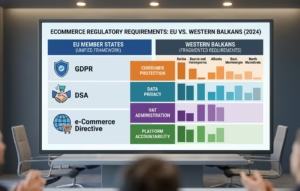
| Regulatory Area | EU Member States | Non-EU Western Balkans |
|---|---|---|
| Cross-border compliance principle | Country of establishment (single framework travels across borders) | Fragmented national requirements per market |
| Platform accountability | DSA mandates transparency, complaint mechanisms, dark pattern elimination | Partial or no DSA coverage; Albania ~47% uncovered |
| Payment regulation | Standardized under revised Payment Services Directive | Varies substantially in scope and enforcement capacity |
| Product compliance documentation | CE marking and harmonized labeling rules, consistently applied | National-level product safety frameworks with varying standards |
| VAT administration | OSS/IOSS simplification available | Separate customs documentation and country-specific VAT registration required |
| Digital identity and authentication | eIDAS framework with mutual recognition of electronic signatures | Working toward alignment via 3rd Countries Trust List Program; current gaps create friction |
Western Balkan markets don’t offer that luxury. Albania’s gaps in Digital Services Act coverage create real uncertainty around platform transparency obligations and content moderation requirements. Serbia and Bosnia & Herzegovina have made partial progress on electronic commerce fundamentals but diverge significantly on platform liability and consumer withdrawal rights. Payment regulation is another fault line: EU markets benefit from the revised Payment Services Directive’s standardized framework, while electronic payment oversight across the Western Balkans digital regulation varies substantially in both scope and enforcement capacity. For a deeper understanding of this area, consider the current trends and growth opportunities in Balkan digital payment adoption.
Product compliance documentation is where this divergence becomes operationally painful. EU markets enforce CE marking obligations and harmonized labeling rules across all member states – one documentation standard, consistently applied. Non-EU Balkan countries maintain national-level product safety frameworks with varying documentation standards and conformity assessment procedures. Add to this the absence of OSS/IOSS VAT simplification in non-EU markets, and you’re looking at separate customs documentation, individual duty calculations, and country-specific VAT registration processes for each market you enter. That’s not insurmountable, but it requires deliberate operational design from the outset rather than retrofitting compliance onto a system built for EU simplicity.
The regulatory divergence also surfaces in digital identity and authentication standards. EU member states benefit from the eIDAS framework, which establishes mutual recognition of electronic signatures and trust services across borders. Non-EU Western Balkan markets are working toward alignment through the 3rd Countries Trust List Program, but current gaps in electronic signature recognition create friction for cross-border contract execution and identity verification workflows that EU-based sellers take for granted. If your eCommerce model involves subscription agreements, B2B contracts, or age-verified purchases, this is a compliance dimension worth mapping explicitly before you launch in non-EU markets.
These differences aren’t static obstacles – they’re evolving compliance landscapes that reward businesses who track convergence trends and build adaptable systems. The key is recognizing which gaps are temporary (and closing predictably) versus which represent fundamental structural differences that require permanent operational accommodation.
Data Protection and Privacy – GDPR Compliance vs. Local Frameworks

How Does GDPR Compare to Data Protection Frameworks in Non-EU Balkan Markets?
- EU member states (GDPR): Explicit consent for personal data processing, transparent privacy notices, comprehensive individual rights (access, portability, erasure, rectification), and penalties of up to €20 million or 4% of annual worldwide turnover for non-compliance.
- Kosovo and North Macedonia: Meaningful convergence with EU data protection standards; compliance adaptation is relatively straightforward for GDPR-compliant operators.
- Serbia and Bosnia & Herzegovina: Partial alignment on data processing fundamentals; diverge on enforcement mechanisms and implementation of individual rights in practice.
- Albania: Most significant gaps, with substantial portions of platform transparency and data governance obligations uncovered by existing law.
GDPR sets the standard across EU member states in the Balkans, and if you’re already operating in Croatia, Bulgaria, Romania, Greece, or Slovenia, you know what that means in practice: explicit consent for personal data processing, transparent privacy notices, comprehensive individual rights covering access, portability, erasure, and rectification, and penalties of up to €20 million or 4% of annual worldwide turnover for non-compliance. These aren’t aspirational guidelines – they’re enforced, and the financial exposure is real.
When you move into non-EU Western Balkan markets, the picture fragments considerably. Kosovo and North Macedonia show meaningful convergence with EU data protection regulations, making compliance adaptation relatively straightforward if you’re already GDPR-compliant. Serbia and Bosnia & Herzegovina have partial alignment on data processing fundamentals but diverge on enforcement mechanisms and how individual rights are implemented in practice. Albania presents the most significant gaps, with its legislative framework leaving substantial portions of platform transparency and data governance obligations uncovered by existing law.
The operational challenge this creates is concrete: you can’t simply apply your GDPR compliance stack uniformly across all Balkan markets and assume you’re covered. Each non-EU market requires a specific review of consent requirements, data localization rules, and breach notification procedures. The most practical approach is to treat your GDPR framework as the ceiling – the highest standard you’ll meet – and then map each non-EU market’s requirements against it to identify where you need market-specific adaptations rather than building parallel systems from scratch. This approach is both cost-efficient and forward-looking, since non-EU markets are actively converging toward GDPR-equivalent standards as part of the EU accession process.
One area where this matters immediately is cookie consent and tracking technology. Your GDPR-compliant consent management platform likely implements strict opt-in requirements and granular consent controls. Some non-EU Balkan markets have less stringent requirements, but building to the higher standard protects you as regulations tighten and demonstrates consumer respect that builds trust in markets where online privacy laws concerns are growing. The businesses seeing the strongest customer lifetime value in these markets are those treating Balkan data compliance as a competitive advantage rather than a compliance checkbox.
Consumer Protection Standards and Cross-Border Transactions
EU member states in the Balkans enforce a harmonized consumer protection baseline that shapes every aspect of how you structure your eCommerce operations. The 14-day right of withdrawal for distance contracts isn’t optional – it’s a floor, not a ceiling. Sellers must provide transparent pre-contractual information, clear return procedures, standardized refund timelines, accurate product information, full pricing transparency including shipping costs, and explicit contract terms before purchase completion. For cross-border sellers operating across Croatia, Bulgaria, Romania, Greece, and Slovenia, this harmonization is genuinely valuable: one compliance framework covers all five markets.
Non-EU Western Balkan markets lack this harmonized baseline, which means withdrawal rights, dispute resolution mechanisms, and consumer rights recourse options vary by country. Serbia and Bosnia & Herzegovina have partial alignment on distance selling fundamentals, but enforcement capacity and consumer protection authority accessibility differ meaningfully from EU standards. Albania’s framework shows significant gaps in online consumer protection. For you as a seller, this means your return policy, your pre-purchase disclosures, and your dispute resolution process may need market-specific versions rather than a single regional standard.
One EU-specific regulation worth understanding clearly is the geoblocking regulations prohibition, which prevents unjustified discrimination based on nationality or place of residence. Within the EU, you cannot automatically re-route customers to country-specific websites or restrict payment methods based on location – all EU consumers must receive consistent access and pricing. Non-EU Western Balkan markets operate outside this framework entirely, which gives you more flexibility in how you structure market-specific access and pricing, but also means consumers in those markets may encounter friction that EU-standard shoppers wouldn’t accept. How you handle that friction – through transparent communication rather than silent restrictions – will directly affect your conversion rates and customer satisfaction scores in those markets.
Cross-border eCommerce dispute resolution is another area where the EU-non-EU divide creates practical asymmetry. EU member states participate in the Online Dispute Resolution platform, giving consumers a standardized channel for resolving cross-border complaints. Non-EU Balkan markets have no equivalent mechanism, meaning dispute escalation paths are less predictable and more resource-intensive for both sellers and consumers. Building clear, accessible dispute resolution language into your non-EU market terms of service – and backing it with responsive customer support – is both a compliance best practice and a competitive differentiator in markets where consumer trust in online retail is still developing.
The practical takeaway: design your consumer protection framework to exceed EU standards, then adapt selectively for non-EU markets rather than building down from minimal compliance. This approach future-proofs your operations as Western Balkan markets continue converging toward EU norms and positions you as a trustworthy seller in markets where that reputation drives measurable commercial advantage.
The Digital Services Act and Its Implications for the Western Balkans
What Does the Digital Services Act Require from eCommerce Platforms?
The Digital Services Act represents the most significant reshaping of platform accountability in the EU since the original eCommerce Directive. Within EU member states, the DSA mandates:
- User-friendly complaint mechanisms: Platforms must provide accessible channels for users to flag unlawful content or products.
- Random checks on unlawful products: Online marketplaces must conduct proactive checks on products sold through their platforms.
- Cooperation with trusted flaggers: Platforms must prioritize notices from designated trusted flaggers regarding illegal content.
- Advertising transparency: Clear disclosure of the parameters used to target advertising to users.
- Elimination of dark patterns: User interfaces must not manipulate users into unintended decisions.
- Very large platform obligations: Risk assessments, content moderation transparency reporting, and external auditing for platforms exceeding defined thresholds.
For Western Balkans digital transformation markets, DSA compliance is both a regulatory challenge and a strategic signal. The third Regulatory Dialogue between the EU and the Western Balkans in 2024 positioned digital transformation as a central priority, with all six economies now associated with the Digital Europe Programme and with five economies (Albania, Kosovo, Montenegro, North Macedonia, Serbia) launching European Digital Innovation Hubs in January 2025 and Bosnia and Herzegovina following a separate track (expected 2026). Albania’s current legislative framework leaves approximately 47% of DSA-related provisions uncovered, creating substantial gaps in platform regulations transparency and intermediary liability that EU member states treat as baseline standards. Kosovo and North Macedonia are further along the convergence path, while Serbia and Bosnia & Herzegovina maintain intermediate positions.
The practical implication for your platform strategy is this: if you build your compliance architecture to DSA standards now, you’re not just meeting current EU requirements – you’re positioning yourself ahead of the regulatory curve in non-EU markets that are actively working toward alignment. The “know your business customer” obligations, compliance-by-design frameworks, and institutional monitoring capacities that the DSA requires are coming to Western Balkan markets as part of the accession process. Building them in from the start is significantly less expensive than retrofitting them later.
This forward-looking approach also creates competitive differentiation. Platforms that demonstrate DSA-level transparency and accountability in markets where it’s not yet required signal operational maturity and consumer respect that builds trust faster than competitors operating at minimum local compliance levels. As Western Balkan consumers become more sophisticated about platform accountability – a trend accelerating with increased digital adoption – the businesses that treated DSA principles as best practices rather than regulatory burdens will have established market positions that are difficult to displace.
Practical Strategies for Navigating Regulatory Divergence in Balkan eCommerce

How to Build a Tiered Compliance Architecture for Balkan eCommerce
- Establish your universal foundation. Implement GDPR data handling, 14-day withdrawal rights, transparent pre-contractual information, and OSS/IOSS VAT reporting as baseline standards that apply across all markets.
- Map non-EU market-specific requirements. Review Serbia’s consumer protection provisions, Albania’s data governance gaps, and Bosnia & Herzegovina’s customs documentation requirements as targeted adaptations rather than separate operational tracks.
- Eliminate surprise friction in customs and delivery. Build explicit transparency about import costs, duty variables, and extended delivery windows into your checkout flow for non-EU markets – this is both a compliance requirement and a conversion optimization tactic.
- Audit your technology stack before launch. Review consent management platforms, cookie compliance tools, and data subject request workflows against each target market’s requirements before deployment, not after your first regulatory inquiry.
- Engage with European Digital Innovation Hubs. Five of the six Western Balkan economies (Albania, Kosovo, Montenegro, North Macedonia, and Serbia) had European Digital Innovation Hubs operational from January 2025; Bosnia and Herzegovina is completing a separate selection process (expected 2026) – use them proactively as institutional touchpoints for regulatory guidance and technical support.
- Document your compliance decisions and rationale. When regulations change – particularly in Western Balkan markets moving toward EU accession – clear documentation makes adaptation faster and less expensive than reverse-engineering earlier decisions.
The most effective operational framework for Balkan eCommerce isn’t a single compliance system or a fully parallel set of country-specific systems – it’s a tiered architecture that treats EU baseline standards as the foundation and layers market-specific requirements on top as controlled variations. Start by implementing GDPR data handling, 14-day withdrawal rights, transparent pre-contractual information, and OSS/IOSS VAT reporting as your universal foundation. Then map each non-EU market’s specific requirements – Serbia’s consumer protection provisions, Albania’s data governance gaps, Bosnia & Herzegovina’s customs documentation requirements – as targeted adaptations rather than separate operational tracks. This approach keeps your core processes consistent while giving you the flexibility to meet market-specific obligations without rebuilding from scratch each time. This approach aligns with proven market penetration strategies for entering new markets in CEE and the Balkans.
Customs and delivery promise management deserves particular attention in non-EU markets. EU cross-border lanes benefit from predictable timelines and simplified VAT administration; non-EU lanes involve customs clearance variables, potential duty costs, and extended delivery windows that reflect border processing realities. The operational priority here is eliminating surprise friction. Customers in non-EU markets who understand import costs and delivery timelines at checkout consistently demonstrate higher conversion rates and lower support overhead than those who encounter unexpected fees or delays after purchase. These are some of the hidden barriers of selling beyond the EU that require careful consideration. Build that transparency into your checkout flow explicitly – it’s a conversion optimization tactic as much as a compliance management requirement.
Technology stack decisions also carry compliance implications that are easy to underestimate at the planning stage. Consent management platforms, cookie compliance tools, and data subject request workflows that you’ve configured for GDPR need market-specific review before deployment in non-EU Balkan markets. Some tools assume GDPR as the universal standard and don’t surface the configuration options needed for markets with different consent thresholds or breach notification timelines. Audit your tech stack against each target market’s requirements before launch, not after your first regulatory inquiry.
For businesses planning broader regional expansion, the Digital Europe Programme association provides meaningful strategic leverage. Five of the six Western Balkan economies launched European Digital Innovation Hubs in January 2025; Bosnia and Herzegovina is following a separate selection track expected to conclude in 2026, creating institutional touchpoints for navigating regulatory adaptation requirements and accessing technical support for digital acquis alignment. Engage with these hubs proactively – they’re designed to support exactly the kind of cross-border compliance challenges you’re managing. The third Regulatory Dialogue’s emphasis on digital transformation as central to EU integration also means that legislative changes in non-EU markets are increasingly predictable in direction, even if timing varies. Forward-looking businesses that anticipate convergence rather than react to it will have a meaningful first-mover advantage as alignment accelerates.
One final strategic consideration: document your compliance decisions and their rationale as you build. When regulations change – and they will, particularly in Western Balkan markets moving toward EU accession – having clear documentation of why you implemented specific controls and how they map to regulatory requirements makes adaptation dramatically faster and less expensive than reverse-engineering decisions made months or years earlier.
Future Outlook – Harmonization Efforts and Digital Integration

The trajectory of regulatory convergence between EU member states and Western Balkan markets is structured and accelerating. The Digital Europe Programme’s €8.1 billion budget for 2021–2027 is accessible to businesses, organizations, and public administrations from Western Balkan countries through association agreements, creating real technical support infrastructure for regulatory adaptation. Priority areas in the regulatory dialogue include data governance and free flow of data, with Western Balkan countries working toward alignment with the Open Data Directive, the Regulation on Free Flow of Non-Personal Data, the European Data Governance Act, and the forthcoming Data Act – all of which establish baseline interoperability standards that directly affect digital commerce operations.
Digital identity and trust services represent a particularly tangible convergence lever. Western Balkan progress toward mutual recognition of electronic signatures and seals through the 3rd Countries Trust List Program will reduce authentication friction for cross-border transactions. Cybersecurity cooperation under the regulatory dialogue – including transposition of the NIS Directive and implementation of the EU 5G Cybersecurity toolbox, with regional involvement from the European Union Agency for Cybersecurity (ENISA) – strengthens the platform security and consumer trust frameworks that underpin eCommerce operations across both EU and non-EU markets. For eCommerce operators, the message is clear: the compliance gap is closing, and the businesses that build toward convergence today will be best positioned when it does.
The practical implication for your strategic planning is straightforward: treat Western Balkan regulatory alignment as a when question, not an if question. The institutional infrastructure, financial resources, and political commitment are in place to drive convergence through 2027 and beyond. This forward-looking approach is crucial for scaling eCommerce across the Balkans & CEE with effective cross-border growth and localization strategies. Businesses that design their compliance architecture with this trajectory in mind – building to EU standards even in markets where they’re not yet required – will avoid costly system overhauls and gain first-mover advantages as harmonization accelerates. The EU-Western Balkans cooperation you’re navigating today is temporary; the operational capabilities you build to manage it will compound as the region integrates through digital market integration.
Frequently Asked Questions
- Which non-EU Balkan countries are closest to EU eCommerce regulatory standards? Kosovo and North Macedonia demonstrate the highest convergence with EU standards among non-EU Western Balkan markets. Serbia and Bosnia & Herzegovina occupy intermediate positions, while Albania currently has the most significant gaps, with approximately 47% of Digital Services Act-related provisions uncovered by existing law.
- Do I need separate GDPR compliance processes for each Balkan market? For EU member states – Croatia, Bulgaria, Romania, Greece, and Slovenia – your GDPR framework applies uniformly. For non-EU markets, you need market-specific reviews of consent requirements, data localization rules, and breach notification procedures. Treat your GDPR stack as the ceiling and map each non-EU market’s requirements against it to identify targeted adaptations.
- How does the OSS/IOSS VAT simplification affect non-EU Balkan market entry? OSS/IOSS mechanisms are only available within the EU, meaning non-EU Balkan markets require separate customs documentation, individual duty calculations, and country-specific VAT registration. Factor this operational complexity into your market entry strategies cost modeling from the outset.
- What is the Digital Services Act’s most immediate impact on eCommerce platforms? The DSA requires online marketplaces to implement user-friendly complaint mechanisms, perform random checks on unlawful products, eliminate dark patterns, and maintain advertising transparency. Very large platforms face additional risk assessment and external auditing obligations. These requirements apply now in EU member states and are being progressively adopted across Western Balkan markets.
- How should I structure delivery promises for non-EU Balkan markets? Be explicit about customs clearance variables, potential duty costs, and extended delivery windows at checkout. Customers who understand these factors upfront convert better and generate less support overhead than those who encounter unexpected fees or delays post-purchase. Transparency is both a compliance requirement and a conversion optimization tactic.
- What does the EU geoblocking regulation mean for my Balkan pricing strategy? Within EU member states, you cannot restrict access or differentiate pricing based on customer nationality or location. Non-EU Western Balkan markets are outside this framework, giving you more flexibility – but market-specific restrictions can create friction for consumers accustomed to EU-standard cross-border shopping experiences.
- How can the Digital Europe Programme help my business navigate Western Balkan compliance? All six Western Balkan economies are associated with the Digital Europe Programme and will host European Digital Innovation Hubs by 2025. These hubs provide institutional touchpoints for regulatory guidance and technical support for digital acquis alignment – engage with them proactively as part of your Balkan market expansion strategy.
- What is the most cost-effective compliance architecture for multi-market Balkan operations? A tiered system works best: implement EU baseline standards – GDPR, 14-day withdrawal rights, transparent pre-contractual information, OSS/IOSS VAT reporting – as your universal foundation, then layer market-specific requirements for non-EU countries as controlled variations. This avoids the cost of building parallel systems while maintaining the flexibility to meet country-specific obligations.
- When should I expect significant regulatory convergence in non-EU Balkan markets? The Digital Europe Programme runs through 2027, and the third Regulatory Dialogue in 2024 reinforced digital transformation as a central EU accession priority. Legislative alignment is directionally predictable, though timing varies by country and provision. Build toward convergence now rather than waiting to react – first-mover advantage in compliant market entry is real.
- What KPIs should I track to measure compliance effectiveness across Balkan markets? Track return rate by market (a proxy for consumer protection compliance quality), checkout abandonment rate in non-EU markets (indicating friction from duty and customs transparency), data breach incident rate, regulatory penalty exposure by jurisdiction, and customer support ticket volume related to delivery or returns. These metrics connect compliance performance directly to commercial outcomes.
References
- EUR-Lex – Regulation (EU) 2021/694 establishing the Digital Europe Programme. Official total budget: €8.168 billion for 2021–2027.
- European Western Balkans – DSA Alignment Research (2024). Albania: approximately 47% of DSA-related provisions uncovered by current national legislation.
- European Commission – Digital Europe Programme. Official programme page covering Western Balkans association and EDIH commitments by 2025.
- EUR-Lex – Digital Services Act (Regulation EU 2022/2065). Obligations for online platforms within EU member states.
- European Commission – Consumer Rights Online. 14-day withdrawal right under Consumer Rights Directive 2011/83/EU.
- Open Society Foundation Western Balkans – Digital regulation mapping in Western Balkans countries.